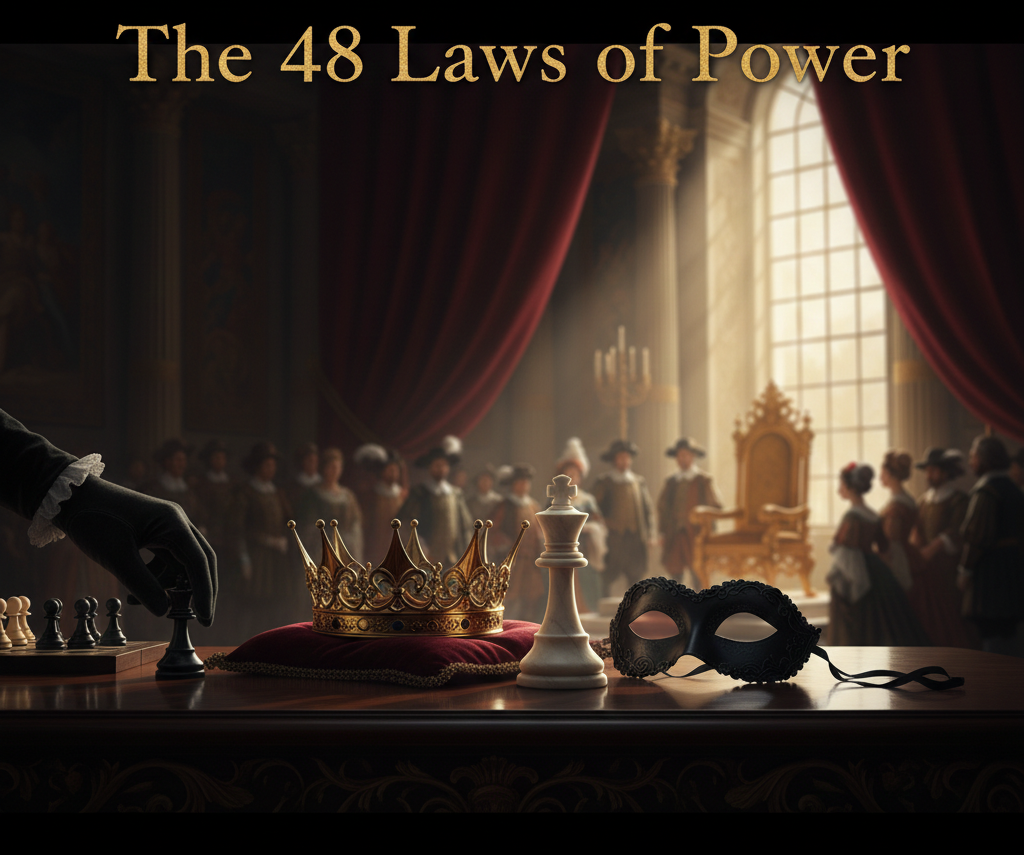
The feeling of having no power over people and events is generally unbearable; when we feel helpless, we feel miserable. In the modern world, while it is dangerous to appear too power-hungry or overt with your maneuvers, the reality remains that everyone wants more power. To navigate this world successfully, one must become a “perfect courtier,” a master of indirection, charm, and subtle strategy who can make others bend to their will without them even realizing it.
Drawing from the timeless wisdom of the sources, this article explores how you can re-create your identity, guard your reputation, and master the social dynamics that govern human interaction.
The Psychology of the Power Game
Power is essentially amoral. To master it, you must learn to look at circumstances rather than judging them as “good” or “evil”. The most crucial foundation for this is the ability to master your emotions. Emotional responses are the single greatest barrier to power; they cloud reason and prevent you from seeing a situation clearly. Anger, specifically, is the most destructive response, as it creates a ripple effect that makes situations less controllable.
Furthermore, you must beware of those who claim to be “nonplayers.” These individuals often use their supposed weakness or perfect honesty as a power strategy to convince others of their noble character. In truth, the world is like a giant, scheming court, and if the game is inescapable, it is better to be an artist at it than a bungler.

Law 1: Never Outshine the Master
The most critical rule for those climbing the ladder of success is to always make those above you feel comfortably superior. In your desire to impress them, if you go too far in displaying your talents, you may inspire fear and insecurity instead.
Consider the fate of Nicolas Fouquet, Louis XIV’s finance minister. In 1561, Fouquet threw the most spectacular party the world had ever seen to commemorate his new chateau. He intended it as a tribute to the king, but it backfired. Louis XIV, a man of intense vanity, felt outdone by Fouquet’s elegance and connections. The very next day, Fouquet was arrested and spent the rest of his life in solitary confinement.
Key Strategy: If you are more intelligent than your master, seem the opposite. Make your advice seem like an echo of their own ideas. By letting others outshine you, you remain in control of their insecurities rather than becoming a victim of them.
Law 3: Conceal Your Intentions
To maintain the upper hand, you must keep people off-balance and in the dark. If your rivals have no clue what you are up to, they cannot prepare a defense.
The sources suggest two powerful techniques for this:
- Red Herrings: Dangle an object you seem to desire in front of people’s eyes, and they will take that appearance for reality. While they focus on the decoy, they fail to notice your true goal.
- Smoke Screens: Use a bland, unreadable exterior—like a “poker face”—to hide your maneuvers. A helpful or apparently honest gesture can also serve as a diversionary device to win trust before you strike.
Law 5: Reputation: Guard It With Your Life
Reputation is the cornerstone of power. Through reputation alone, you can intimidate others and win without a fight; however, once it slips, you become vulnerable to attack from all sides.
In the beginning, you must work to establish a reputation for one outstanding quality—whether it be generosity, honesty, or efficiency. This quality becomes a “calling card” that precedes you and places others under a spell.
The Lesson of the “Sleeping Dragon”: During the War of the Three Kingdoms, the great general Chuko Liang sat on a city wall, alone and playing a lute, while an army of 150,000 approached. His reputation for being the cleverest man in China was so great that the enemy general, Sima Yi, feared a trap and ordered an immediate retreat. Such is the power of an unassailable reputation.

Law 25: Re-create Yourself
Do not accept the roles that society foists upon you. Instead, forge a new identity that commands attention and never bores the audience. This process requires self-consciousness and the adoption of the plasticity of an actor.
Julius Caesar was a master of this, treating his public appearances as carefully scripted theatrical events. He used grand gestures and surprise announcements to heighten the drama of his rule. Similarly, George Sand (born Aurore Dupin Dudevant) re-created herself by adopting a male persona to break into the male-dominated literary world of 19th-century Paris. By creating a larger-than-life character, she became the master of her own image rather than letting others define her.
Law 48: Assume Formlessness
The most effective way to protect yourself is to be as fluid and formless as water. By taking a visible shape or having a fixed plan, you open yourself to attack.
The history of Sparta and Athens illustrates this clearly. Sparta created a rigid society dedicated solely to warfare. While they were powerful for a time, they could not adapt to change and eventually collapsed. Athens, conversely, was fluid and creative, adapting to every new problem with ingenuity.
In the modern world, you must train yourself to take nothing personally. Never act defensive, as that reveals a “clear form” for your enemies to target. If you remain ungraspable, your enemies will wear themselves out trying to figure you out, while you maintain the initiative.
Conclusion: The Art of the Indirect Route
Power is a social game that requires you to be a master psychologist. To truly succeed, you must learn to take the indirect route. Like a billiard ball that caroms several times before hitting its target, your moves must be planned in the least obvious way.
By mastering these laws, you spare yourself the pain of “bungling with power” and instead become an artist of social influence. Remember: The ending is everything. Plan all the way to it, taking into account every possible obstacle, so that you are never overwhelmed by circumstances.

Leave a Reply